When comparing car insurance policies, you will often come across the word deductible.
But what exactly does it mean? 🤔
A car insurance deductible is an amount that the insured may be required to pay toward a covered claim before the insurance company pays the remaining eligible amount.
The concept is relatively simple, but deductibles can have a significant effect on the cost of your insurance and the amount you may have to pay after an accident.
In some countries, a similar concept is commonly referred to as an insurance excess.
Understanding how deductibles work can help you compare car insurance policies and avoid unexpected costs when making a claim.
💡 Important: Deductibles, excesses, coverage rules, and claim procedures vary between countries, insurers, and policies. Always check the terms of your specific insurance contract.
What Is a Car Insurance Deductible? 🛡️
A car insurance deductible is the amount of an eligible loss that the insured is responsible for paying under the terms of the policy.
For example, imagine your vehicle suffers:
$5,000 in covered damage
and your policy has a:
$500 deductible
If the deductible applies to the claim, you may be responsible for the first $500.
The insurer would then potentially cover:
$5,000 − $500 = $4,500
subject to the policy’s terms, limits, and exclusions.
So, in simple terms:
Claim amount − applicable deductible = potential amount covered by the insurer
However, this is only a simplified example. Real insurance claims can involve different coverage rules and calculations.
Deductible vs. Premium: What’s the Difference? 💰
The deductible and premium are two completely different things.
💰 Premium
The premium is the amount you pay for your insurance policy.
For example:
$800 per year
💳 Deductible
The deductible is an amount you may have to pay if you make a covered claim.
For example:
$500 deductible
You pay the premium whether or not you have an accident.
The deductible generally becomes relevant when an eligible claim occurs.
| Premium | Deductible | |
|---|---|---|
| 💰 What is it? | Cost of insurance | Amount potentially paid toward a claim |
| 📅 When is it paid? | According to payment schedule | Usually when an applicable claim occurs |
| 🚗 Applies to | Maintaining coverage | Certain covered losses |
| 📊 Can affect price? | Yes | Often, yes |
How Does a Deductible Work After an Accident? 🚗💥
Imagine you have an accident and your vehicle requires repairs.
The repair estimate is:
$3,000
Your applicable deductible is:
$500
If the damage is covered and the deductible applies:
$3,000 − $500 = $2,500
You may therefore be responsible for $500, while the insurer covers the remaining eligible $2,500.
But what happens if the damage is less than the deductible?
What If the Damage Is Less Than the Deductible? 🤔
Suppose your deductible is:
$1,000
but the repair costs only:
$700
If the deductible applies to the claim, the insurance company may not make a payment because the damage is below the deductible amount.
In this example, you would potentially pay the entire $700.
This is one reason why understanding your deductible is important before purchasing a policy.
Does a Higher Deductible Mean a Lower Premium? 📉
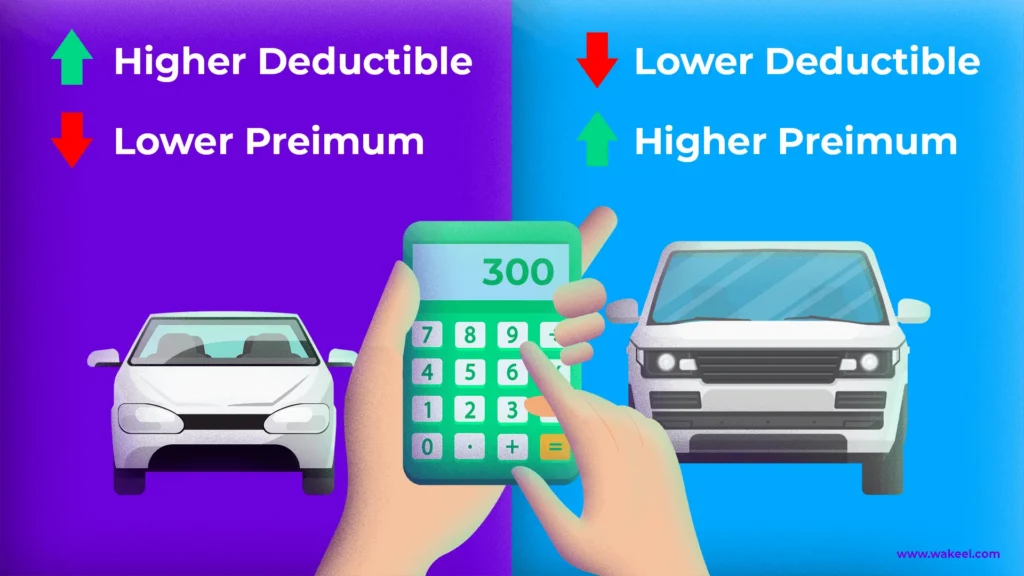
In many insurance products, choosing a higher deductible can be associated with a lower premium.
For example:
| Option | Annual premium | Deductible |
|---|---|---|
| A | $1,000 | $250 |
| B | $850 | $750 |
| C | $700 | $1,500 |
The exact relationship depends on the insurer.
The general idea is that accepting more potential out-of-pocket cost can sometimes reduce the amount you pay for the insurance itself.
However, you should consider whether you could comfortably afford the deductible after an accident.
What Is the Best Deductible? 🤔
There is no universal deductible that is appropriate for every driver.
A lower deductible can mean:
- 💳 Less to pay when an applicable claim occurs.
- 💰 Potentially higher insurance premiums.
A higher deductible can mean:
- 💰 Potentially lower premiums.
- 💳 More money to pay if an applicable claim occurs.
The important question is not simply:
«Which deductible is cheapest?»
Instead, consider:
«How much could I realistically afford to pay after an accident?»
Example: Comparing Two Policies 📊
Imagine you are choosing between two hypothetical policies.
Policy A
Premium: $1,000/year
Deductible: $250
Policy B
Premium: $750/year
Deductible: $1,500
Policy B saves you:
$250 per year
But if you have a covered claim where the $1,500 deductible applies, your potential out-of-pocket cost could be substantially higher.
Over several years without a claim, the lower premium may result in lower total insurance payments.
However, after a significant claim, the higher deductible could require a much larger immediate payment.
This is why deductibles should always be considered together with the premium and coverage.
Are Deductibles Applied to Every Claim? 🧾
Not necessarily.
The deductible can depend on the type of coverage involved and the specific terms of your policy.
For example, a policy could have different deductibles for different situations.
You might find:
- 🚗 Collision damage: $500.
- 🌧️ Certain weather damage: $750.
- 🔐 Theft: $1,000.
- 🪟 Glass damage: Different terms.
These are only examples.
Your actual policy may use a completely different structure.
Always check the coverage section of your insurance contract.
What Is a Zero-Deductible Policy? 0️⃣
Some insurance products may offer coverage with no deductible for certain types of claims.
This is sometimes described as:
$0 deductible
In that case, if the claim is covered and the relevant coverage has a zero deductible, you may not have to pay a deductible toward that particular claim.
However, a zero deductible does not mean that the policy covers everything.
There can still be:
- Exclusions.
- Coverage limits.
- Conditions.
- Other restrictions.
Always read the policy details.
What Is an Insurance Excess? 🌍
In some countries, the term «excess» is commonly used instead of «deductible.»
The underlying concept can be similar: the policyholder is responsible for a specified amount of an eligible claim before the insurer covers the remaining amount according to the policy.
However, the exact meaning and structure of an excess can vary between insurance systems.
This is particularly important if you are comparing car insurance internationally.
Compulsory vs. Voluntary Deductibles 📋
Some insurance policies may distinguish between different types of deductibles or excesses.
For example:
Compulsory deductible
An amount established by the policy that applies regardless of whether you voluntarily selected it.
Voluntary deductible
An amount you choose when purchasing the policy, potentially in exchange for a different premium.
The terminology and availability of these structures vary between countries and insurers.
What Should You Consider When Choosing a Deductible? 🔎
Before choosing your deductible, consider:
💰 Your budget
Could you afford the deductible if you needed to make a claim?
📅 Your driving frequency
Someone who drives very frequently may have different considerations from someone who rarely drives.
🚗 Vehicle value
A higher-value vehicle may make the potential financial exposure more significant.
🛡️ Your coverage
Different types of coverage can have different deductibles.
📉 Premium difference
Calculate how much you actually save by choosing a higher deductible.
A Simple Way to Compare Deductibles 🧮
Imagine two policies:
Policy A
- Premium: $1,000
- Deductible: $500
Policy B
- Premium: $800
- Deductible: $1,500
Policy B costs $200 less per year.
But its deductible is $1,000 higher.
If you rarely make claims, the lower premium may be important.
If you have a covered claim, however, the difference in deductible could become significant.
This illustrates why insurance comparison should consider both recurring costs and potential claim costs.
Common Mistakes About Car Insurance Deductibles ❌
❌ Assuming every claim has the same deductible
Different coverage types may have different deductibles.
❌ Choosing the highest deductible simply to reduce the premium
Make sure you could afford it if a claim occurs.
❌ Assuming a deductible applies to every situation
Read the specific coverage terms.
❌ Forgetting about deductibles when comparing policies
A lower premium may come with a higher deductible.
❌ Assuming a zero deductible means unlimited coverage
Coverage limits and exclusions can still apply.
Car Insurance Deductible Checklist ✅
Before buying or renewing your insurance, check:
- 💳 What is the deductible?
- 🚗 Which types of claims does it apply to?
- 📊 Are there different deductibles for different coverages?
- 💰 How does the deductible affect the premium?
- 🧮 Could you afford the deductible after an accident?
- ⚠️ Are there situations where the deductible does not apply?
- 📄 Is the deductible clearly stated in your policy?
Frequently Asked Questions ❓
What is a car insurance deductible?
A deductible is an amount that the insured may have to pay toward a covered claim before the insurer pays the remaining eligible amount.
Is a higher deductible better?
Not necessarily. A higher deductible may reduce the premium in some policies, but it also means you may have to pay more if an applicable claim occurs.
Does every car insurance policy have a deductible?
Not necessarily. Some policies or specific coverages may have no deductible, while others may use different deductible structures.
Is a deductible the same as an excess?
In many markets, «excess» is used for a concept similar to a deductible. However, terminology and specific rules vary between insurance systems.
What happens if my repair costs less than my deductible?
If the deductible applies, the insurer may not make a payment when the eligible loss is below the deductible amount.
Can I choose my deductible?
Some insurers offer different deductible options, while others determine the deductible as part of the policy. Availability varies by market and insurer.
Conclusion: Understand Your Deductible Before You Need It 💳🚗
A car insurance deductible can have a significant impact on both your insurance premium and your potential costs after a covered claim.
When comparing policies, don’t look only at the monthly or annual price.
Look at the complete picture:
💰 Premium + 💳 Deductible + 🛡️ Coverage + 📊 Limits + ⚠️ Exclusions
A lower deductible may mean paying more for the policy, while a higher deductible may reduce the premium but increase your potential out-of-pocket costs after a claim.
The right choice depends on your circumstances, budget, vehicle, and the coverage available in your market.
Most importantly, know your deductible before an accident happens. That way, you won’t discover its impact for the first time when you need to make a claim.